
Tactical Gear OEM/ODM RFQ Guide: Specifications, Samples, MOQ, Quality Control, and Lead Time
Introduction
A strong tactical gear RFQ should tell the supplier what the product is, how it will be used, which details are fixed, which can be recommended, how many units are needed, where they will ship, and how quality will be accepted. Include a tech pack or reference sample when available, material and component requirements, sizes and colors, branding, packaging, tests, inspection plan, target schedule, and trade term.
This information does more than improve the first quotation. It allows a manufacturer to identify development work, material minimums, production risks, and decisions that affect cost or timing. It also makes supplier quotations comparable. A short message asking for “your best price on 1,000 tactical uniforms” may produce a number, but it does not create a dependable commercial offer.
The guide below is designed for importers, distributors, private-label brands, uniform dealers, outdoor companies, and institutional procurement teams sourcing tactical apparel and sewn tactical gear.
The complete RFQ at a glance
| RFQ section | Minimum information | Commercial effect |
|---|---|---|
| Buyer and market | Company, destination, sales channel, intended user | Helps assess labeling and product fit |
| Product definition | Product type, reference, dimensions, use case | Establishes scope |
| Development model | OEM, ODM, private label, or open recommendation | Clarifies design responsibility |
| Materials and components | Fabric, webbing, zippers, buckles, foam, thread | Drives performance, MOQ, and cost |
| Sizes/colors/quantity | Quantity by SKU, color, and size | Enables material and line planning |
| Branding | Logo method, labels, artwork, placement | Affects sampling and setup |
| Testing and QC | Methods, criteria, inspection plan | Defines acceptance |
| Packaging | Unit pack, barcode, carton, manuals | Prevents end-stage changes |
| Timing | Sample date, approval date, delivery window | Enables a realistic critical path |
| Shipping | Destination and Incoterm | Makes quotations comparable |
OEM, ODM, and private label: define the project model
The terms are used inconsistently, so describe the actual work rather than relying on the acronym.
OEM: buyer-controlled product definition
In a typical OEM project, the buyer supplies or owns the product design, tech pack, reference sample, artwork, or performance specification. The manufacturer develops and produces against those requirements. The RFQ should state what files are available, who owns the design, whether the factory may propose engineering changes, and how revisions are approved.
OEM is appropriate when product differentiation, fit, construction, materials, or brand standards are already defined. It usually requires more development control than adding a logo to an existing item.
ODM: adapting a manufacturer-developed platform
In an ODM project, the buyer selects or adapts an existing factory-developed design. Customization may include fabric, color, pockets, hardware, branding, labels, packaging, or selected construction details. The RFQ should identify which base style is being considered and which changes are requested.
ODM can reduce development uncertainty when the base product is close to the customer requirements, but changes still need a controlled specification and approved sample. A modified stock style is not automatically ready for bulk production.
Private label: branding an established product
Private label usually means applying the buyer’s brand and packaging to an existing or minimally changed product. Confirm which attributes remain standard, available colors and sizes, branding methods, labeling, packing, and any restrictions on market exclusivity.
The project model affects design responsibility, sample rounds, tooling or setup, ownership, MOQ, and lead time. Put it in writing before price comparison.
Section 1: buyer, market, and intended application
Introduce the buying company, destination market, sales channel, and product application. A distributor building a permanent range has different priorities from a one-time promotional order or institutional tender.
Useful details include:
- company name and website;
- buyer contact and technical contact;
- destination country and delivery location;
- importer, distributor, brand, dealer, retailer, or project buyer;
- intended use: training, outdoor, security, duty, airsoft, workwear, or general field use;
- target customer and price position;
- applicable tender, legal, labeling, or restricted-substance requirements.
Do not describe a commercial product as certified, protective, flame-resistant, ballistic, infrared-compliant, or military-specification unless the exact standard, scope, test evidence, and authorization are established.
Section 2: product definition and reference information
Identify each requested product with a unique working code. Attach the best available reference: tech pack, drawing, annotated photographs, physical sample, specification sheet, or link. State whether the reference is for appearance only or should be copied in dimensions and construction.
For apparel, include front and back views, measurement chart, grade rules, construction callouts, pocket dimensions, reinforcement locations, closure details, size range, and fit intent. For packs and load-bearing items, include dimensions, capacity, compartment layout, webbing arrangement, strap range, foam structure, hardware, load path, and attachment requirements.
Mark every uncertain item as “supplier proposal requested.” This is much safer than leaving a blank that each supplier will interpret differently.
Section 3: materials and components
Build a preliminary BOM even if the manufacturer will refine it. Depending on product type, specify:
- shell, reinforcement, lining, mesh, rib, and pocketing fabrics;
- fiber composition, construction, finished weight, width, color, and finish;
- webbing material, width, thickness, color, and pattern;
- zipper chain, slider, puller, length, color, and brand or approved equivalent;
- buckles, adjusters, snaps, hooks, rings, and other hardware;
- foam density or thickness and reinforcement boards;
- elastic, cord, hook-and-loop, binding, and thread;
- labels, patches, hangtags, polybags, inserts, and cartons.
If a named branded component is mandatory, require written confirmation that the quotation includes it. If equivalents are acceptable, define the performance and approval process. Ask the factory to flag components with high MOQ, long procurement time, limited colors, or supplier risk.
Section 4: color, camouflage, and artwork
Provide a recognized color reference or physical standard. For custom colors, ask for a lab dip. For printed camouflage, request a strike-off and define repeat, scale, orientation, color standards, and intellectual-property authorization.
Artwork files should be vector where possible and include dimensions, placement, color, technique, and acceptable tolerance. State whether the branding is embroidery, woven label, rubber patch, heat transfer, screen print, debossing, or another process. Mockups are useful for placement but should not replace production artwork.
Define who approves lab dips, strike-offs, embroidery samples, patches, labels, and carton marks. Late artwork approval is a common cause of schedule slippage.
Section 5: quantities, SKU structure, and forecast
State total quantity and the breakdown by product, color, size, and version. “1,000 sets” is incomplete if the order contains six sizes, four colors, and separate top and pant assortments.
Provide the first order and, when realistic, the expected repeat pattern. A forecast is not a purchase commitment, but it can help the supplier discuss material reservation, stock colors, packaging inventory, and replenishment planning. Clearly label forecasts as estimates.
If the first quantity is not fixed, request price breaks using the same specification, such as 300, 500, 1,000, and 3,000 units. The factory should explain which breakpoints reflect material purchasing, production efficiency, or packaging—not merely produce unrelated numbers.
What determines tactical gear MOQ?
There is no universal tactical gear MOQ. It is usually the highest practical constraint among materials, dyeing or printing, trims, branding setup, packaging, cutting efficiency, and production-line economics.
Ask for separate answers to these questions:
- What is the garment or finished-product MOQ per style?
- What is the MOQ per color or camouflage?
- Which fabric or component has the highest minimum?
- Can stock materials reduce the MOQ?
- How is excess custom material charged, stored, or returned?
- Does the MOQ change for custom labels, patches, or retail packaging?
- Can sizes be mixed, and is there a minimum per size?
A credible supplier may need to confirm material availability before fixing MOQ. Treat a fast, universal answer as an estimate until the BOM and color are approved.
Section 6: sample stages and approval gates
Specify the sample stage you need and what it must prove.
Development or prototype sample
Used to review concept, dimensions, construction, and major material choices. Substitute materials may be acceptable if clearly identified and if they do not invalidate the evaluation.
Fit or size-set sample
Used to approve fit, movement, grading, and measurements. For tactical apparel, review the garment with intended layers, belts, packs, or protective equipment where relevant.
Material and branding approvals
Approve fabric swatches, lab dips, print strike-offs, hardware, zipper, webbing, hook-and-loop, embroidery, patch, labels, and packing materials. Track each item with a code and approval date.
Pre-production sample
Produced from intended bulk materials and construction after specifications are frozen. It should represent what the production line will make. Identify the approved sample and retain matching references with the buyer and factory.
State sample quantity, cost, courier responsibility, required date, revision rounds, approval method, and whether sample charges are refundable or credited. These terms vary by supplier and project; do not assume.
Mid-article CTA — Submit a Structured RFQ
Have a tech pack, reference sample, or product idea? Send the product type, quantity, destination, branding, material preference, and required date. We will identify missing inputs before quotation. Start Your RFQ
Section 7: testing and quality acceptance
Translate quality language into a written control plan. Separate:
- material tests, such as composition, mass, tensile or tear strength, abrasion, colorfastness, dimensional change, or finish performance;
- construction checks, such as seam type, stitch density, bartacks, reinforcement, binding, webbing alignment, measurements, symmetry, and component function;
- appearance criteria, such as stains, shade, loose threads, puckering, print defects, or logo placement;
- packing checks, such as labels, barcode, assortment, polybag, carton quantity, marks, dimensions, and weight;
- critical requirements, where nonconformance could create safety, legal, functional, or brand risk.
Name the test method and acceptance threshold. ASTM and AATCC publish recognized textile methods, but a method alone is not a product requirement. The buyer must define the pass value and whether results are required from the mill, factory, or independent laboratory.
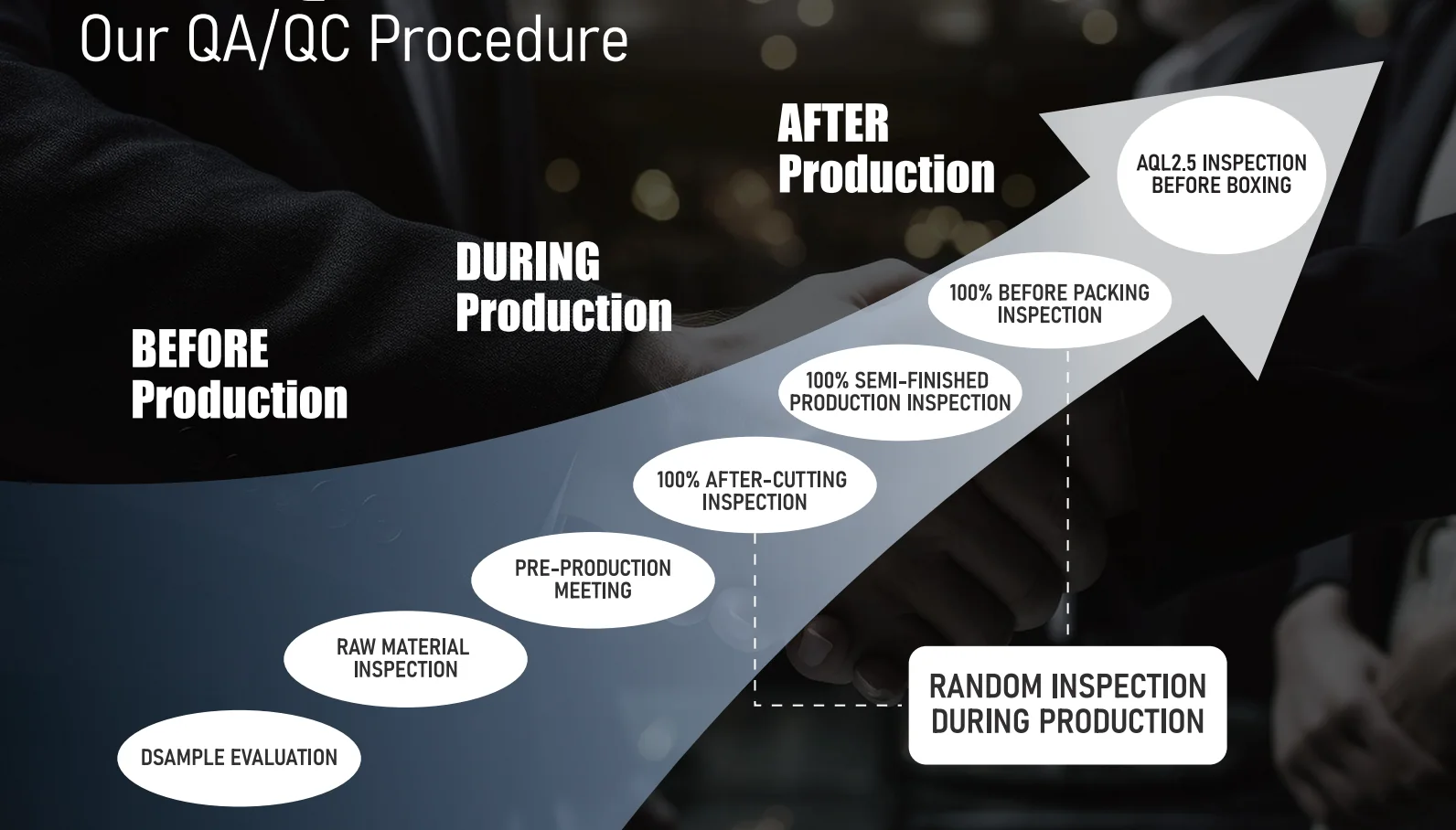
For lot inspection, ISO 2859-1 provides sampling schemes indexed by acceptance quality limit. If using AQL, specify inspection level, AQL for each defect class, critical-defect policy, sample selection, and failed-inspection procedure. Sampling does not mean that the permitted defect rate is a quality target.
Section 8: factory and shipment inspection
State whether the buyer, factory, or independent inspection company will perform the inspection and at what production stage. Options may include first-piece, in-line, pre-final, and pre-shipment inspection.
Shipment inspection should compare goods against the purchase order, approved specification, BOM, artwork, color standard, and sealed sample. It may verify:
- quantity, style, size, and color assortment;
- workmanship and measurements;
- zippers, closures, adjustment, and attachment function;
- material identity and visible shade consistency;
- labels, warnings, care information, and barcode data;
- accessories and spare parts;
- individual packaging and carton marks;
- carton count, gross/net weight, and dimensions;
- damage, moisture, contamination, or mixed goods.
Agree who pays for reinspection and how corrective work, replacement, discount, or shipment delay will be handled after a failed result.
Section 9: packaging and destination preparation
Packaging is part of the product specification. Provide individual packing method, fold, size sticker, barcode format, warning text, hangtag, inserts, pieces per carton, carton quality, carton marks, pallet requirements, and any retailer routing guide.
Installation preparation may apply to accessories, modular components, display sets, or products that require assembly. State whether straps, pads, cords, buckles, or hardware should arrive installed, partially assembled, or packed separately. Include diagrams when setup is not obvious.
Before shipment, validate barcode scans and carton assortment using real production packaging. A correct product in the wrong labeled carton can still cause receiving failure and chargebacks.
Section 10: lead time and the critical path
There is no single “good” lead time for custom tactical gear. It depends on development complexity, material availability, dyeing or printing, component sourcing, sample approvals, testing, order size, production loading, inspection, packing, and transport.
Ask the supplier for a milestone schedule with:
- requirement review complete;
- quotation and commercial confirmation;
- sample materials ready;
- prototype or fit sample submission;
- buyer comments and approval;
- lab dip, strike-off, and branding approval;
- pre-production sample approval;
- bulk material arrival and incoming inspection;
- cutting and production start;
- in-line quality review;
- final packing and shipment inspection;
- goods ready date;
- transport estimate to destination.
Define when production lead time begins. It may begin after deposit and all approvals, not on the date of the first inquiry. Separate “goods ready” from port departure and final delivery. National holidays, peak seasons, custom materials, buyer comment cycles, and failed tests should appear as planning risks rather than hidden buffers.
Section 11: quotation format and commercial terms
Request a quotation that states:
- product and specification revision;
- unit price by quantity tier and currency;
- sample and development charges;
- tooling, printing, embroidery, patch, label, or packaging setup;
- material assumptions and named components;
- included testing or inspection;
- packing configuration;
- Incoterm and named place;
- payment terms;
- MOQ by style/color/size where relevant;
- sample and production lead-time assumptions;
- quotation validity;
- exclusions and optional upgrades.
Normalize these elements before comparing suppliers. EXW, FOB, CIF, and DDP prices do not represent the same scope. Incoterms allocate responsibilities and costs; they do not replace a shipping quote, customs classification, import compliance review, or cargo insurance decision.
Section 12: shipment documents
List required documents in the purchase order. Depending on destination and terms, these may include commercial invoice, packing list, bill of lading or air waybill, certificate of origin, inspection report, test report, material declaration, or buyer-specific forms.
Document requirements vary by country and product. Confirm them with the importer, customs broker, tender authority, or qualified adviser before production. A factory should not invent compliance statements to complete a form.
Copy-and-use tactical gear RFQ template
Subject: RFQ — [Product] — [Estimated Quantity] — [Destination]
Buyer and market
Company:
Destination country/port:
Sales channel/end user:
Intended product application:
Product scope
Product name and working SKU:
OEM / ODM / private label:
Reference files or sample available:
Fixed requirements:
Supplier recommendations requested:
Materials and construction
Main fabric and weight:
Reinforcement/lining/mesh:
Webbing, zipper, buckles, hook-and-loop, thread:
Color/camouflage:
Finish or treatment:
Key dimensions/construction points:
Order structure
Quantity by style/color/size:
Expected repeat order or forecast, if any:
Branding and labels
Logo method, artwork size, and placement:
Main/care/size labels:
Hangtag/barcode/retail requirements:
Quality and testing
Required methods and pass criteria:
Inspection plan/AQL:
Third-party inspection required: Yes / No / To discuss
Packaging and shipping
Individual packing:
Pieces per carton and carton marks:
Incoterm and named place:
Required shipment documents:
Schedule
Sample required by:
Target goods-ready date:
Target delivery date:
Please quote
MOQ, price tiers, sample cost, sample lead time, production lead time, payment terms, quotation validity, optional materials, and any missing or conflicting requirements.
Common RFQ mistakes
Asking for price before defining the product
This produces assumptions that differ by supplier. Provide a minimum specification and require every assumption to be shown.
Hiding the target market or use
The product application influences material, labeling, testing, packaging, and liability. Share enough context for the supplier to flag risks.
Treating a photograph as a complete specification
A photo does not reveal fiber content, internal construction, seam allowance, component grade, dimensions, or performance. Annotate it and list unknowns.
Requesting “military grade” without a standard
The phrase is not a measurable requirement. Name the exact specification, revision, test method, acceptance value, and evidence required.
Setting a delivery date without approval deadlines
Buyers influence lead time through comments, artwork, color approval, sample approval, payment, and shipping decisions. Put buyer and supplier milestones on one schedule.
Changing labels and packaging after production
Late changes may require unpacking, relabeling, reinspection, and new cartons. Approve destination preparation before bulk packing begins.
FAQ
What should I include in my first message to a tactical gear manufacturer?
Include product type, intended use, reference images or tech pack, estimated quantity, colors and sizes, material preference, branding, destination, required date, and tests or certifications that are genuinely required. Ask the supplier to list missing information and assumptions.
What is a typical MOQ for custom tactical apparel?
There is no responsible universal number. MOQ depends on fabric and trim minimums, colors, size mix, branding, packaging, and production complexity. Ask for MOQ per style and color plus the material minimum driving it.
How long does an OEM tactical gear order take?
Timing varies with development rounds, custom materials, approvals, testing, production capacity, inspection, and transport. Request a milestone schedule and define whether the quoted lead time begins after deposit, sample approval, artwork approval, or material confirmation.
Do I need a tech pack?
A tech pack is the clearest basis for custom OEM work, but a factory can often begin discussion from an annotated reference sample, drawings, or photographs. Missing decisions should be documented and resolved before bulk production.
When should I use ODM instead of OEM?
Use ODM when an existing manufacturer-developed style is close to your needs and the permitted modifications cover your market requirements. Use OEM when you need tighter control of original design, fit, materials, construction, or performance.
What quality controls should a tactical gear factory provide?
The plan should match the product and may include incoming material inspection, first-piece approval, in-line checks, measurement and function checks, final inspection, packing verification, and shipment inspection. The supplier should define records, responsibilities, defect criteria, and corrective action.
Should I disclose my target price?
It can be useful when paired with non-negotiable requirements. A target price helps the supplier propose realistic material or construction options, but it should not replace a transparent quotation and specification comparison.
Conclusion
A professional RFQ converts an idea into a controlled sourcing project. It defines the product, identifies open decisions, separates OEM from ODM or private label, and gives suppliers enough information to quote the same scope. It also establishes the sample, quality, packaging, and scheduling rules that will govern production.
The objective is not to make the first email unnecessarily long. It is to remove expensive ambiguity early. Start with the template, attach the strongest available reference, and ask the manufacturer to identify missing inputs before confirming price, MOQ, or lead time.
CTA: submit your tactical gear RFQ
Send your product reference, tech pack, target quantity, market, material preference, colors, branding, packaging, and required date. Emersongear can review the customer requirements and respond with the clarification points needed for a responsible sample and quotation discussion.